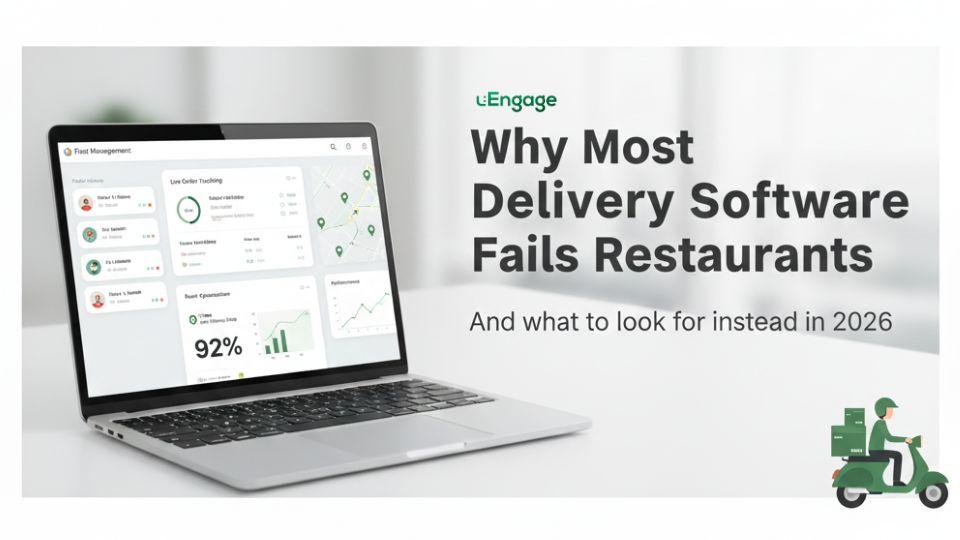
Restaurants today don’t have a delivery volume problem.
They have a delivery systems problem.
On paper, many restaurants are already using delivery software.
In reality, operations are still messy, delayed, and stressful.
Late orders.
Angry customers.
Overworked teams.
Rising costs.
So the real question in 2026 is not “Do we need delivery software?”
It’s:
“Why is our delivery software still not working?”
This is exactly why choosing the best delivery management software has become a critical decision for modern restaurant brands.
The Hard Truth: Most Delivery Software Isn’t Built for Restaurants
A lot of delivery tools look impressive in demos.
Dashboards, maps, buttons, charts.
But once restaurants go live, cracks start appearing.
Why?
Because most delivery software is:
-
Built for logistics companies, not restaurants
-
Designed for single-location use
-
Dependent on manual workflows
-
Not flexible for peak-hour chaos
“If your delivery tool needs people to constantly fix things, the tool has already failed.”
Common Reasons Delivery Software Fails Restaurants
Let’s break down the real reasons
1. No Understanding of Restaurant Operations
Restaurants don’t operate like warehouses.
They deal with:
-
Peak-hour spikes
-
Kitchen prep delays
-
Multiple order channels
-
Mixed delivery models (in-house 3PL)
Most generic tools can’t adapt to this reality.
That’s why restaurants struggle to find the best delivery management software that actually fits daily operations.
2. Manual Dispatch Still Exists (Big Red Flag)
If your team is:
-
Assigning riders manually
-
Calling delivery partners
-
Switching between apps
Then the software is not solving the problem, it’s just sitting on top of it.
Manual dispatch does not scale.
Automation does.
3. Poor Fleet & Rider Visibility
Many tools show orders, but not riders.
Without proper fleet management:
-
Riders get overloaded
-
Delays go unnoticed
-
Performance can’t be measured
This is why restaurants need delivery systems with built-in fleet management software for restaurants, not add-ons.
4. Weak Route Optimization
Static routes don’t work in real life.
Traffic changes.
Order density changes.
Peak hours change everything.
Without dynamic routing, deliveries slow down and costs increase.
Restaurants using route optimization reduce delivery time by 20–30%.
Any platform claiming to be the best delivery management software must handle routing intelligently.
5. No Unified Delivery View
Most growing brands use:
-
In-house riders
-
Multiple 3PL partners
-
Different order channels
If these don’t come together in one place, chaos follows.
This is where unified delivery management becomes essential.
The Real Cost of Using the Wrong Delivery Software
Poor delivery systems don’t just cause delays, they damage the brand.
Consider this:
-
60% of negative food delivery reviews are delivery-related
-
Restaurants lose up to 25% repeat customers due to bad delivery experiences
-
Support costs increase significantly due to “Where is my order?” queries
“Customers forgive late food once.
They don’t forgive uncertainty.”
What Restaurants Should Look for Instead in 2026
So what actually works?
Here’s what separates failing tools from the best delivery management software
1. Centralised Delivery Control
Restaurants need one dashboard to:
-
View all orders
-
Assign deliveries automatically
-
Monitor real-time status
-
Handle exceptions quickly
Centralisation reduces confusion and speeds up decisions.
2. Built-In Fleet Management
The right platform should support:
-
Rider availability tracking
-
Performance metrics
-
Delivery time benchmarking
-
Shift & workload planning
This is where delivery operations management for restaurants becomes structured instead of reactive.
3. Smart Route Optimization
In 2026, route planning must be:
-
Dynamic
-
Traffic-aware
-
Order-density aware
This directly improves customer satisfaction and reduces delivery costs.
4. Real-Time Delivery Tracking
Transparency builds trust.
Real-time tracking:
-
Reduces customer anxiety
-
Cuts down support calls
-
Improves post-order experience
For customers, delivery tracking is no longer a feature, it’s an expectation.
5. Unified Delivery Across In-House & 3PLs
The best delivery management software allows restaurants to:
-
Manage all delivery partners from one place
-
Standardise workflows
-
Track performance across partners
This is critical for multi-location brands.
Testimonial-Style Example
A growing restaurant chain faced:
-
Daily delivery delays
-
Manual coordination chaos
-
Increasing customer complaints
After switching to a restaurant-first delivery platform:
-
On-time deliveries improved by 40%
-
Support tickets dropped
-
Customer ratings stabilised
The difference wasn’t effort.
It was the system.
Why 2026 Is the Make-or-Break Year for Delivery Tech
Three major shifts are happening together:
-
Delivery volumes are higher than ever
-
Customer patience is lower than ever
-
Restaurants can’t afford inefficiency
This is why more brands are actively searching for the best delivery management software instead of “any delivery tool”.
How uEngage Flash Gets Delivery Right
uEngage Flash is built specifically for restaurant delivery complexity.
It enables:
-
Centralised delivery operations
-
Fleet & partner management
-
Smart route optimisation
-
Real-time delivery tracking
-
Unified delivery visibility
Flash helps restaurants implement delivery operations management for restaurants that scales smoothly with growth.
Final Thoughts
Most delivery software doesn’t fail because it’s broken.
It fails because it was never designed for restaurants in the first place.
In 2026, the winning brands are not those delivering the most orders,
but those delivering the best experience, consistently.
“Strong delivery systems don’t just move food.
They protect your brand reputation.”
Choosing the best delivery management software is no longer a tech decision.
It’s a business survival decision.