
By 2026, technology adoption will no longer be the biggest challenge for restaurant brands. Most already use CRMs, loyalty tools, online ordering systems, delivery software, and marketing automation platforms.
Yet growth remains uneven.
Repeat orders plateau, margins come under pressure, and customer journeys feel increasingly fragmented. According to industry research, the average restaurant brand now manages 5–7 disconnected tools, often leading to operational complexity rather than clarity.
This has brought a critical question to the forefront:
In the debate of CRM vs restaurant growth platforms, is CRM alone really enough to scale restaurant growth in 2026?
What CRM Platforms Are Designed to Do
CRM platforms were built to:
-
centralise customer data
-
track interactions and engagement
-
enable communication and campaigns
-
support segmentation
For restaurants, CRMs helped bring structure to customer information and marketing workflows. They made it easier to understand who customers are and how they respond to outreach.
However, CRMs were never designed to manage commerce or fulfilment, two areas that now directly influence restaurant growth and retention.
This is where the conversation around CRM vs restaurant growth platforms becomes relevant.
Where CRM-Only Platforms Begin to Fall Short
CRM Understands Customers, Not End-to-End Journeys
CRMs are strong at managing profiles and interactions, but restaurant growth depends on end-to-end customer journeys, from ordering to delivery to repeat behaviour.
A 2024 restaurant experience study found that over 60% of customer churn is driven by poor operational experiences, not lack of communication.
Most CRM platforms:
-
sit outside the ordering flow
-
do not influence checkout or conversion
-
lack visibility into delivery execution
Restaurant growth platforms emerged to close this gap by connecting customer data with real-world experiences. Platforms operating in this space, including uEngage, focus on linking engagement insights with ordering and fulfilment outcomes.
Ordering Is the Revenue Engine, But CRM Doesn’t Control It
Online ordering has become one of the strongest growth levers for restaurant brands.
Industry data shows:
-
30–40% of potential orders drop off due to checkout friction
-
Brands optimising direct ordering often see 20–30% higher repeat rates
Yet CRM-only platforms typically:
-
do not manage ordering UX
-
do not optimise checkout flows
-
cannot reduce friction at the point of purchase
This is a key reason why CRM alone is not enough in 2026. Restaurant growth platforms treat ordering as a core growth layer, integrating it with customer insights instead of leaving it siloed.
Delivery Experience Lives Outside the CRM
Delivery performance plays a decisive role in customer retention.
Consumer surveys indicate:
-
1 in 3 customers will not reorder after a poor delivery experience
-
Late or untracked deliveries are among the top drivers of negative brand perception
Most CRMs:
-
offer no delivery routing or optimisation
-
lack live tracking visibility
-
cannot connect delivery outcomes to customer behaviour
Growth platforms aim to address this disconnect by tying delivery management and visibility performance back to customer data, helping restaurants understand how fulfilment impacts loyalty and lifetime value.
Loyalty Needs Behaviour, Not Just Profiles
Traditional CRM-driven loyalty programs often rely on:
-
static point systems
-
generic campaigns
-
manual segmentation
However, modern loyalty strategies are increasingly behaviour-led.
Research shows that behaviour-based loyalty programs can improve repeat visits by up to 40%, especially when rewards are triggered by ordering frequency, basket size, and channel preference.
Restaurant growth platforms are built to incorporate these behavioural signals directly into loyalty logic. Platforms like uEngage reflect this shift by focusing on behaviour-driven restaurant loyalty rather than static profile-based rewards.
Why CRM-Only Platforms Struggle as Restaurants Scale
As restaurant brands grow, complexity increases:
-
more locations
-
more ordering channels
-
higher delivery volumes
-
rising customer expectations
CRMs continue to function as one layer of the tech stack, while growth requires coordination across systems.
This often results in:
-
tool overload
-
data silos
-
manual workarounds
-
slower execution
Industry analysts increasingly note that fragmented stacks slow growth more than lack of tools, reinforcing the shift from CRM-only thinking toward integrated restaurant growth platforms.
Outcomes Matter More Than Dashboards
At the end of the day, restaurants don’t win because a dashboard looks smarter.
They win because orders grow, margins improve, and customers come back more often.
This is the gap many CRM-only platforms struggle to address. They optimise visibility, but not outcomes.
Restaurant growth platforms are designed around this shift, focusing on how systems work together to drive measurable business results, rather than how data is displayed.
Platforms like uEngage operate within this outcome-led approach by aligning ordering, delivery, loyalty, and customer insights into a connected growth framework.
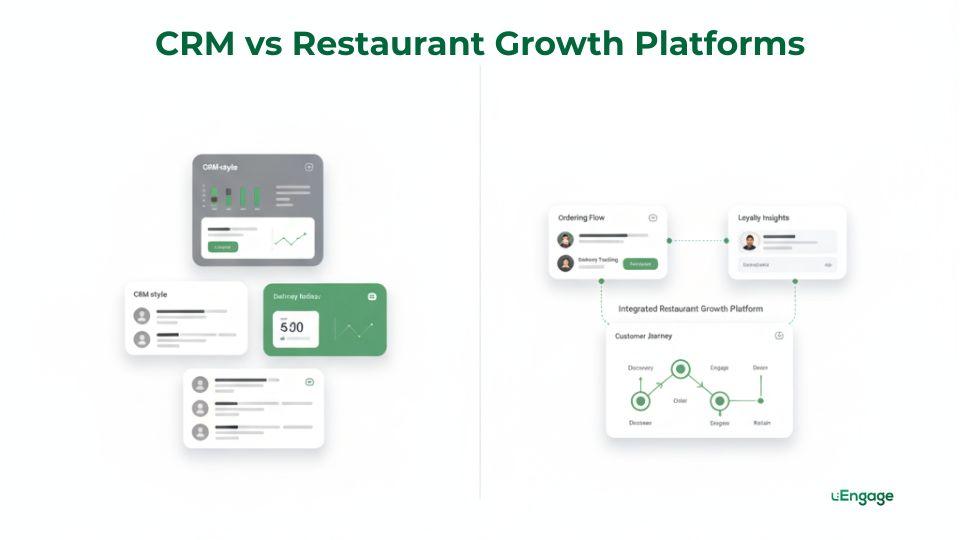
CRM vs Restaurant Growth Platforms: A Structural Difference
| CRM Platforms | Restaurant Growth Platforms |
|---|---|
| Focus on customer records | Focus on customer journeys |
| Communication-centric | Revenue & experience-centric |
| Limited ordering influence | Ordering is integrated into growth |
| Delivery data disconnected | Delivery linked to engagement |
| Fragmented stack | More unified ecosystem |
This structural difference explains why many growing brands are reassessing CRM-first strategies.
From CRM-First Thinking to Growth Infrastructure
The restaurant industry is gradually shifting from CRM-first thinking to growth infrastructure thinking.
As one restaurant technology analyst put it:
“Growth today is less about collecting customer data and more about connecting that data to real-world experiences.”
Growth infrastructure platforms help restaurants align customer insights with execution, without increasing operational complexity.
What This Means for Restaurant Brands in 2026
Restaurant brands that scale effectively tend to:
-
simplify their restaurant tech stack
-
prioritise ownership of customer journeys
-
invest in connected systems rather than isolated tools
They recognise that sustainable growth comes from integration, consistency, and experience, not from adding more software.
Conclusion
CRM platforms remain valuable tools for managing customer data and communication.
However, in the evolving restaurant landscape, CRM alone is no longer enough to support sustainable growth.
The discussion around CRM vs restaurant growth platforms reflects a broader industry shift, toward systems that connect customer data, ordering, delivery, and loyalty into a unified growth framework.
For restaurant brands navigating growth in 2026, success depends less on dashboards and more on outcomes, choosing platforms that help orders grow, margins improve, and customers return more often.
This perspective is also part of our ongoing LinkedIn newsletter, where we share real-world insights on restaurant growth and technology.
Read the discussion on LinkedIn →